TSHD vs CSD: how to tell dredger types apart in satellite imagery
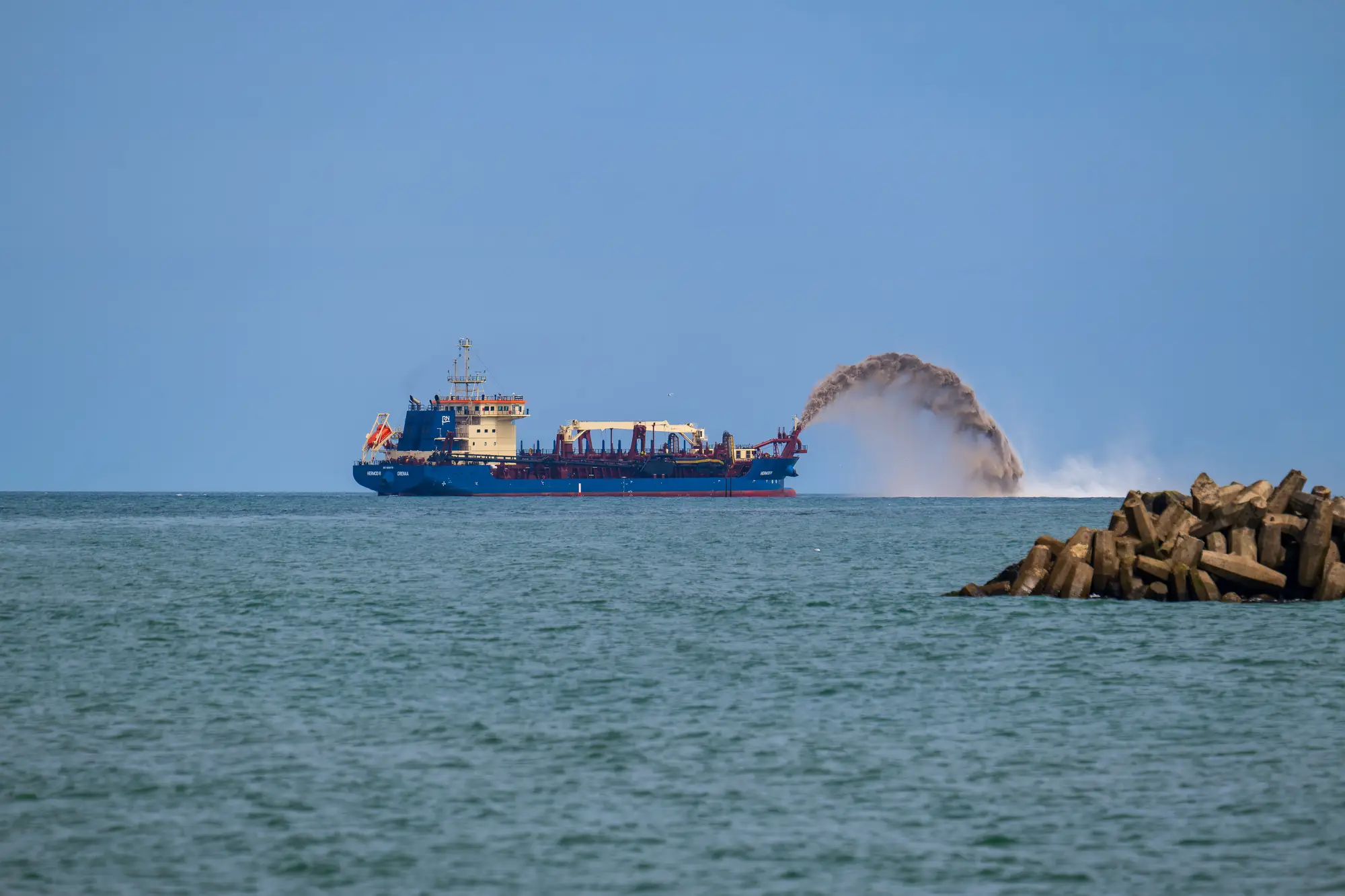
A quarterly pass over a reclamation or deepening project usually shows a dredger somewhere in the frame. Knowing which type it is tells you a lot before you even check the progress report: a trailing suction hopper dredger (TSHD) is moving material from a borrow area to a disposal or fill site, while a cutter suction dredger (CSD) is usually cutting a channel or basin and pumping spoil ashore through a pipeline. The two leave very different fingerprints on imagery, and once you know what to look for, you can call it from a single pass.
Hull shape and position are the first tell
A TSHD looks like a ship, because it is one. Self-propelled, with a pointed bow and a hull that's long relative to its beam, it sits in open water or an approach channel rather than tucked against a quay or breakwater. Look for a pair of drag arms trailing from the hull toward the seabed; on a clear high-res pass they show up as thin lines angled off the stern or sides. Because a TSHD works by steaming a track back and forth between the dredge area and the dump ground, comparing two images taken weeks apart often shows the vessel in a different position entirely, sometimes miles from where it last appeared.
A CSD doesn't look like a vessel so much as a barge with gear bolted on. It's stationary for most of a working cycle, held in place by spuds (vertical anchor piles) rather than steaming under its own power. The giveaway is the cutter ladder, a long arm extending from the bow down into the water at an angle, often resting on the seabed being worked. Because a CSD swings on its spuds to cut in an arc, you'll frequently see it in roughly the same spot across consecutive passes, just rotated a few degrees. If a dredger hasn't moved between quarters, that's already a strong hint you're looking at a CSD rather than a TSHD.
Follow the plume and the pipeline
Sediment plumes behave differently for each type, and the shape is often the fastest tell on a hazy or lower-contrast scene. A TSHD produces a plume that trails behind the hull in the direction of travel, roughly linear or gently curved, because the vessel is moving while it works. A CSD's plume sits around a fixed point and often fans out, because the cutter head is rotating or swinging through a stationary arc.
The other CSD signature a TSHD never has is a visible pipeline. Spoil from a cutter dredger usually gets pumped ashore or to a reclamation cell through floating or submerged pipe, which shows up as a thin straight line running from the dredger toward the fill area, sometimes with a line of buoys marking the route. If you can trace a pipe corridor from the dredger to a growing patch of fill or a spoil ground, you're looking at a CSD. A TSHD instead carries its load in an internal hopper and makes repeat trips to a disposal site, which shows up over successive passes as new material appearing at a dump ground with no pipeline connecting it to the dredger at all.
Why the distinction matters for tracking progress
Getting the dredger type right changes what you expect to see on the next pass. A TSHD working a channel means you're watching for depth changes and disposal volume at a separate dump site, since the fill growth happens there rather than near the vessel itself. A CSD working a basin or reclamation cell means the fill area tied to its pipeline is the thing to watch, and growth there should track roughly with how long the CSD has been on site.
This is the kind of read that's easy from a single clear frame and harder to keep consistent across a dozen projects and a dozen quarters, especially when cloud cover or a different sun angle changes how a plume or pipeline reads from one pass to the next. A change layer built from matched quarterly imagery handles that comparison directly, flagging where a berth line has extended, where reclaimed area has grown, and where spoil ground has expanded, without requiring an analyst to re-identify the dredger type from scratch every time.
If you're tracking berth construction or reclamation progress and want that comparison done automatically each quarter, that's exactly what Port Monitoring is built for.