Jack-up barge vs crane barge: telling them apart in satellite imagery
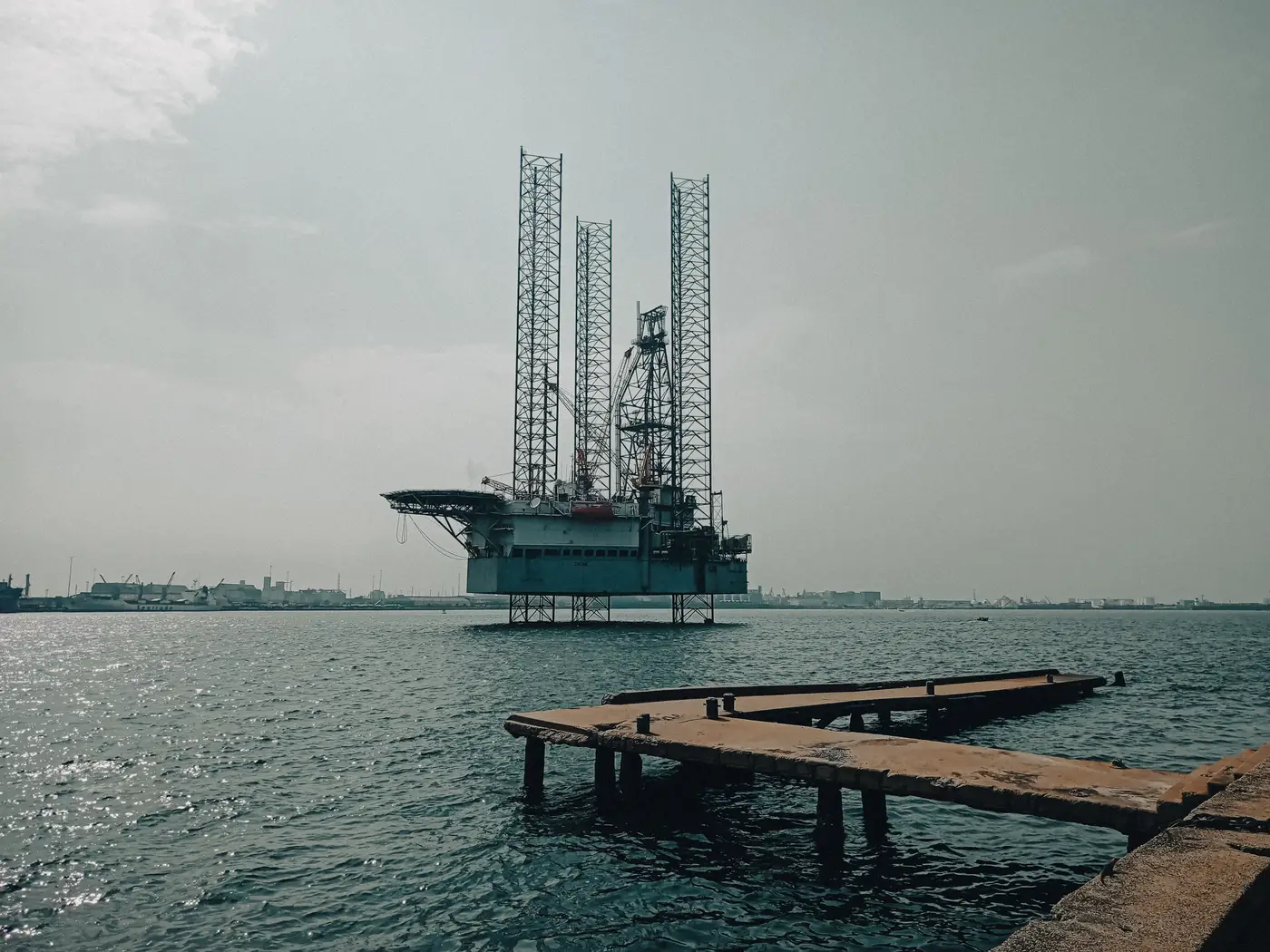
If you're trying to work out what's happening at a berth project from a quarterly pass, the vessel sitting next to the construction line is often the best clue you've got. Press releases lag months behind the work. The barge doesn't lie about what phase you're in, if you know what you're looking at.
Two vessel types show up again and again on berth jobs: jack-up barges and crane barges. They do different work, they look different from above, and mixing them up will throw off your read of where a project actually stands.
What separates a jack-up from a crane barge
A jack-up barge has legs, usually three or four, that lower through the deck and punch into the seabed to lift the whole hull clear of the water. Once jacked up, it sits dead still regardless of tide or swell. That's what makes it the vessel of choice for pile driving: bored piles, driven steel tube piles, anything that needs a fixed, non-moving platform to bore or hammer from. On a berth job, you'll find jack-ups parked along the line where the quay wall or jetty deck is going in.
A crane barge is a flat-deck floating barge with a crane superstructure bolted to it. It doesn't jack itself out of the water. It holds position with anchor lines, spuds, or a mooring tug standing by, and it does the lifting work: setting precast deck panels, placing caissons, dropping armor stone for revetments, handling pipe for a dredge discharge line. Crane barges show up heavier during the fit-out and placement phase, after the piling is mostly done.
Reading the shapes in the imagery
At 0.5-2 m resolution the identification comes down to hull geometry and shadow pattern, since nameplates and deck markings sit far below what the sensor resolves.
Jack-up barges read as a compact rectangular hull with small, distinct point features arranged around its perimeter, the leg footings. Depending on sun angle you'll pick these up as short dark dots just off the hull edge rather than attached to it. The superstructure is low and boxy. Position is exact, pass to pass, because the thing is standing on its own legs. If you line up two quarters and the barge hasn't moved a meter, that's consistent with a jack-up mid-piling run, not drifted off station.
Crane barges throw a long, angled shadow from the boom, often extending well past the hull outline, sometimes twice the barge's own length depending on boom angle and sun position. The hull tends to be longer and narrower than a jack-up's, built for deck space rather than leg wells. You'll often see anchor lines fanning out from the bow and stern as faint linear marks on the water surface, and a smaller support vessel, a tug or anchor-handler, tied up nearby. The crane barge's position can shift a few dozen meters between visits even on the same job, as it works down the line.
Why the vessel type matters for tracking progress
The vessel marks project phase as clearly as anything else in the frame. A jack-up parked along a straight line with small square footings starting to appear beneath it tells you piling is underway and the berth face isn't built yet. A crane barge working the same stretch, with precast panels or caisson units visible stacked nearby, tells you the structural phase is handing off to deck placement or armoring. See both vessel types on the same pass, jack-up further out, crane barge closer in behind it, and you're looking at a project running piling and panel-setting in parallel down the length of the berth.
None of this replaces a proper change detection pass, but it's a useful sanity check when you're trying to read a single image and don't have a prior quarter to compare against. Port Monitoring builds that prior-quarter comparison automatically, flagging where the berth line extended, where reclaimed ground grew, and where spoil ground shifted since the last pass, so you're not left guessing from one frozen frame. If you'd rather see the change layer than reconstruct it by eye, that comparison runs quarter over quarter on the Port Monitoring homepage.